

Disclosure: As an Amazon Associate, I earn from qualifying purchases at no extra cost to you.
There is an old saying in the gardening world: “What grows together, goes together.” While most people know that sweet basil and ripe, homegrown tomatoes are a match made in heaven on a dinner plate, a lot of gardeners don’t realise they are actually secret allies in the dirt, too.
If you are looking to squeeze every square inch of production out of a small urban plot, patio, or courtyard, combining these two crops is the ultimate space-saving hack.
In this guide, I’m breaking down the two exact steps we’ve been running on the homestead this week: cloning a single supermarket basil plant into an infinite supply, and using the “deep-planting” trick to give your Gardener’s Delight cherry tomatoes a massive root system.
Step 1: The Infinite Supermarket Basil Hack
We’ve all done it. You buy one of those lush, bushy pots of live basil from the supermarket, leave it on the kitchen windowsill, water it twice, and within a week it looks like a sad, wilted shadow of its former self.
Supermarket pots are packed way too tightly with dozens of tiny, competing seedlings. Left together, they starve each other out. But there is a secret way to turn that single £1 pot into a lifetime supply of fresh herbs: Water propagation.
How to do it:
- Take the Cuttings: Look closely at your supermarket basil stems. Find a strong, healthy stem and snip it just below a leaf node (the point where new leaves shoot out). Cleanly trim off the lower leaves, leaving just the top clusters.
- The Rooting Phase: Drop those stems into a small glass of clean water and place it on a bright, warm windowsill.
- Watch the Magic Happen: Within 7 to 10 days, you’ll notice bright, clean white roots exploding from the base of the stem. Once those roots are a couple of inches long, they are officially ready to meet their lifelong garden partner: your tomatoes.
Step 2: The “Deep-Planting” Tomato Secret
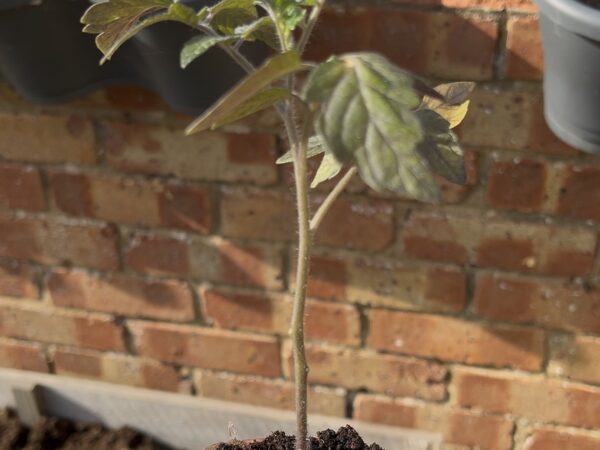
While your basil is rooting, it’s time to get your tomato seedlings ready. This season on the homestead, I’m planting out our Gardener’s Delight cherry tomatoes—a fantastic, heavy-cropping variety that tastes absolutely incredible.
If your seedlings are looking a bit tall, thin, or “leggy” from chasing the early spring light, don’t panic. This is actually a hidden blessing.
 THE STEM SUPERPOWER: Look closely at a tomato stem. See all those tiny, fuzzy hairs? Every single one of those hairs has the biological superpower to turn into a brand-new root the second it makes contact with moist compost.
 THE STEM SUPERPOWER: Look closely at a tomato stem. See all those tiny, fuzzy hairs? Every single one of those hairs has the biological superpower to turn into a brand-new root the second it makes contact with moist compost.
How to plant them:
Instead of planting your tomato seedling shallow (at the same level it sat in its pot), you want to dig a ridiculously deep hole.
Plunge that tomato seedling all the way down into a premium multi-purpose compost until only the very top cluster of leaves is sticking out out of the ground. Firm the soil gently around the stem and give it a deep water.
Over the next two weeks, that buried stem will explode with a massive, dense root system. A larger root system means the plant can draw up double the nutrients, support heavier fruit trusses, and survive hot summer dry spells without wilting.
The Secret Weapon: Vertical Tiered Planting
If you’re dealing with a compact space like a patio or a small backyard, traditional sprawling tomato cages aren’t going to cut it. To make companion planting actually work efficiently, you need to think vertically.
On the homestead, I setup my Gardener’s Delight cherry tomatoes in a specialized vertical frame system.
This is the exact tiered planter setup I use to maximize my growing space. By setting up high-yield cherry tomatoes in the upper tiers, it leaves the perfect amount of space directly underneath to plant your newly rooted basil and a few companion marigolds. It’s sturdy, space-efficient, and brilliant for small gardens or patios.
 My Homestead Setup: The Vertical Tiered Planter
Why This Companion Match-Up Works (According to Science)
Planting your cloned supermarket basil directly at the base of your deep-planted tomatoes isn’t just about saving space—it’s a biological strategy:
- Pest Control: Basil emits powerful aromatic volatile oils. This distinct scent acts as a natural confusion barrier, masking the smell of your tomato plants and driving away common pests like aphids, whiteflies, and hornworms.
- The “Stress Shield”: Recent agricultural studies show that when basil grows alongside tomatoes, the airborne compounds it releases actually prime the tomato plant’s natural defense systems, helping them react faster and stronger to environmental stress or disease.
- Root Protection & Moisture: The shallow, bushy root system of the basil sits perfectly above the deep roots of your tomato plant. The basil acts as a living mulch, shading the top layer of compost and keeping the roots cool and damp during the peak of summer.
By combining a cheap supermarket herb hack with a simple deep-planting trick, you create a self-sustaining, high-yield ecosystem right on your doorstep.