

Disclosure: As an Amazon Associate, I earn from qualifying purchases at no extra cost to you.
It hasn’t rained for weeks here in the Southeast, and the evidence is everywhere. If you walk out into my garden right now, you can see the soil in the strawberry beds beginning to crack and pull away from the edges of the timber. For any urban homesteader, this is the first real “stress test” of the year. When the heat arrives in May, the plants are at their most vulnerable—too young to have deep roots, but too large to ignore.
I decided early on that relying solely on the mains tap wasn’t an option. Not only is it expensive, but it lacks the natural nutrients found in rainwater. This week, I’m walking you through my solution: a robust rainwater harvesting system that is entirely off-grid and cost-effective.
The Power of Free-cycling
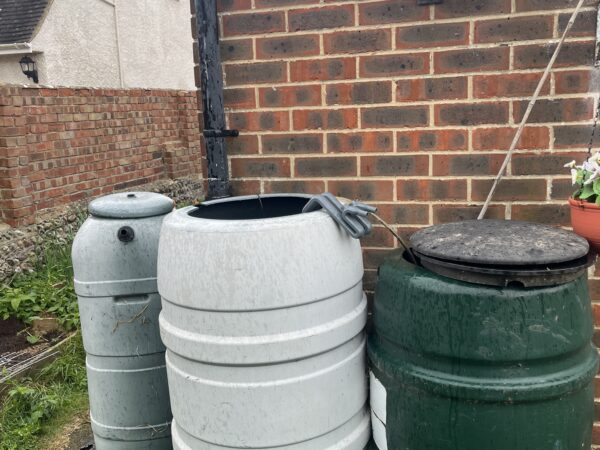
One of the most common myths about homesteading is that you need to spend a fortune at the garden centre to get started. My setup proves the opposite. Of the four water butts I currently have in operation, three were sourced for free from Facebook Marketplace.
While they might look a little “weathered” compared to a brand-new kit, they are structurally sound. In an urban environment, people are often looking to get rid of these large barrels when they move house or redesign their patios. By keeping an eye on local listings, I’ve managed to scale my storage capacity to over 700 litres without breaking the bank.
Linking the System: The Daisy-Chain Method
To maximize my collection from the conservatory roof, I’ve “daisy-chained” my barrels together. Using a simple Water Butt Connection Kit, I’ve linked the primary barrel (which takes the direct flow from the downpipe) to the secondary and tertiary tanks.
The physics is simple: once the first barrel reaches capacity, the water flows through the connection pipe into the next. This ensures that during a heavy Sussex downpour, I’m not losing valuable water to the overflow; instead, I’m filling a massive central reservoir that can see me through weeks of dry weather.
Solving the Pressure Problem with Solar Power
The biggest hurdle with gravity-fed water butts is, quite literally, gravity. If your garden has a slight incline, or if you simply want to use a hose rather than a watering can, a standard tap on a barrel isn’t enough.
My “secret weapon” this year is a Solar Powered Submersible Irrigation Pump. This setup is incredibly straightforward:
- The Pump: A small, waterproof pump sits directly at the bottom of the water butt.
- The Power: A cable runs from the pump to a small solar panel mounted on my fence.
- The Result: As soon as the sun hits the panel, the pump activates, providing enough pressure to power a spray nozzle or a drip line.
Because it is a submersible unit, it is self-priming and stays cool underwater. It costs £0 to run, making it the ultimate tool for a sustainable garden.
Summary: Start Small, Think Big
If you’re facing a dry spring, don’t wait for a hosepipe ban to take action. Start by grabbing a standard 210L Water Buttand getting it under a downpipe. Once you see how quickly it fills, you can scale up.
By combining free-cycled barrels with smart, low-cost tech like solar pumps, you can build a resilient system that saves money, saves your back, and—most importantly—saves your garden during the drought.